Printable download
The Emergency Binder
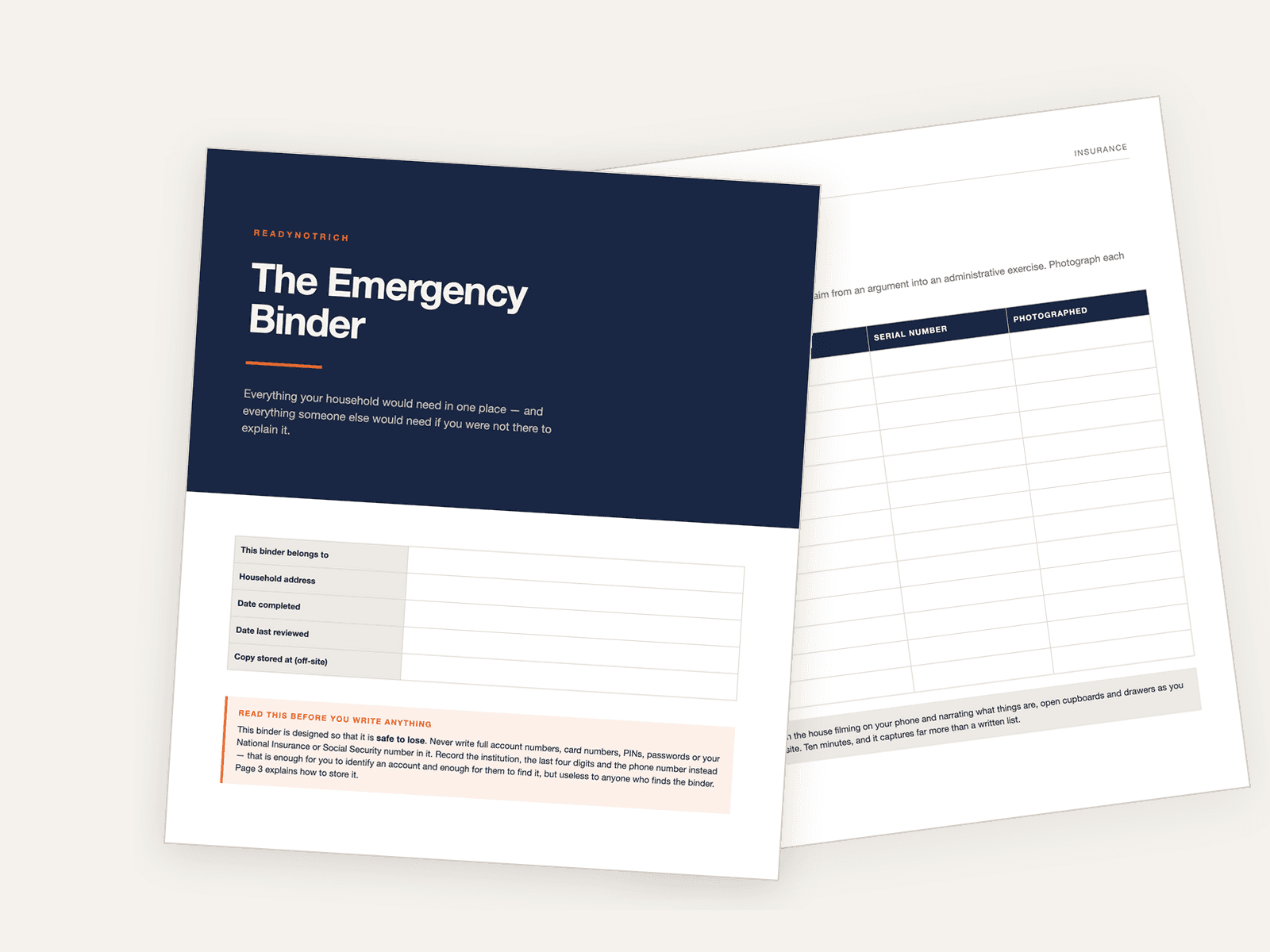
Twenty-two printable pages for the information your household would need in an emergency and could not look up — because the power is out, the phone is gone, or the person who knew it is not there.
Print it, fill it in once, keep it somewhere you would grab it. It works with a flat battery and no signal.
Supplies are the easy half
Most preparedness advice, including most of ours, is about things you can buy: water, food, a torch, a radio, a first aid kit. That part is genuinely useful and it is also the part people find easiest, because it can be solved by shopping.
The other half is information, and it cannot be solved by shopping. When a household is actually under pressure, the questions are administrative and oddly specific. What is the insurance claim line, and what is the policy number. What dose is the prescription, and what is it actually called. Which cupboard is the stopcock behind, and does it turn. Who collects the children if neither parent can. What is the out-of-area number everybody rings when local lines are jammed.
Every one of those answers exists somewhere — in an email, in an app, in someone's head. The failure mode is not that the information is missing. It is that it is scattered across systems that all assume a charged phone, a working connection and a calm person doing the looking.
What is inside
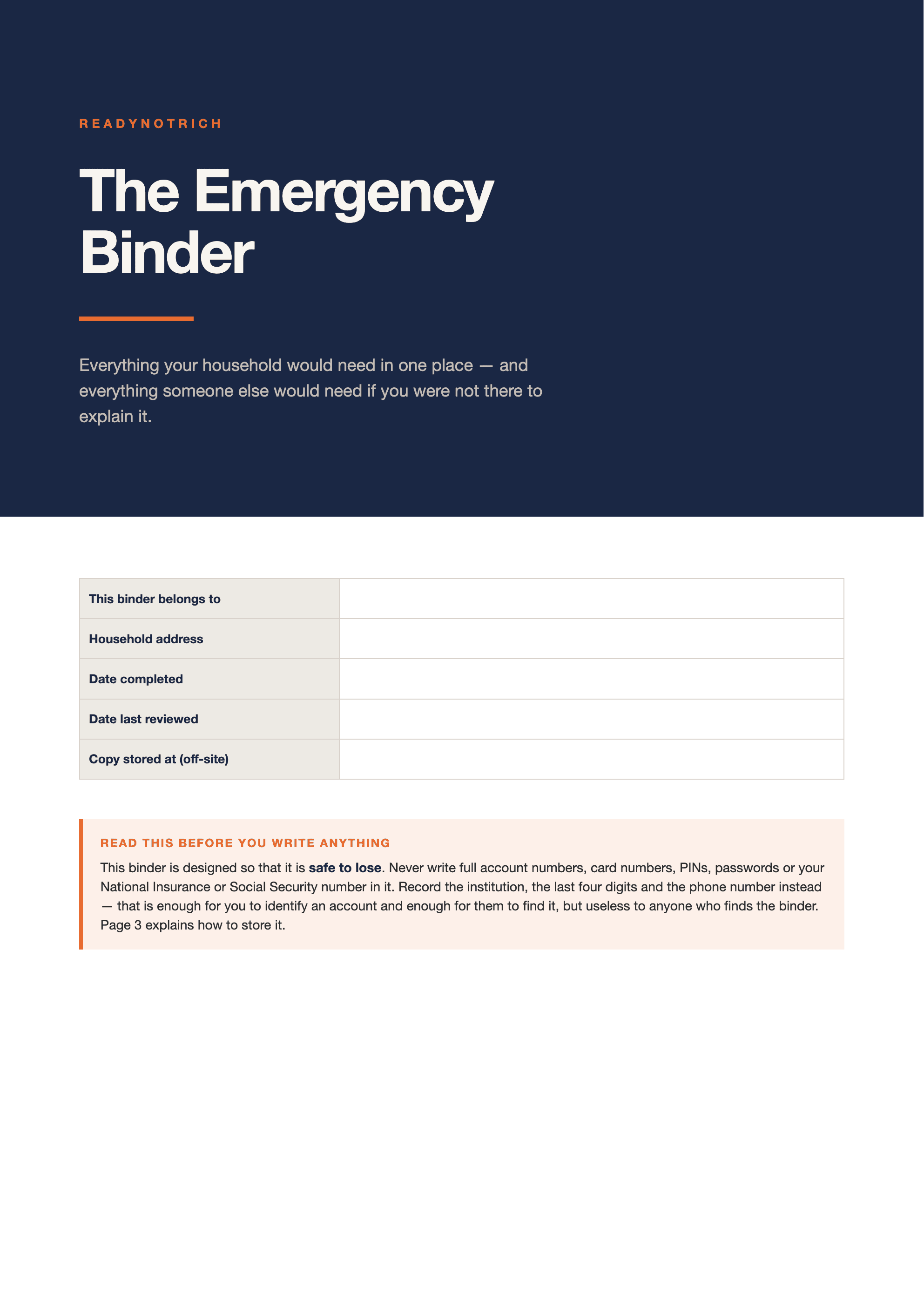
Twenty-two A4 pages, grouped into five parts. Nothing is padding — there is no introduction chapter, no filler essay, and no page that exists to make the count look bigger.
People
- Household members — one full page per person, with two supplied
- Medical summary — conditions, allergies, prescriptions, doses, GP and pharmacy
- Emergency contacts — including the out-of-area contact most plans forget
- Pets — microchip numbers, vet, medication, and who takes them
The house
- Utilities — meter numbers, supplier, and where each shut-off physically is
- Insurance — policy numbers, claim lines, excess, renewal dates
- Property and vehicles — deeds, tenancy, registration, MOT, breakdown cover
- Home inventory — a dense grid for the room-by-room list insurers ask for
Money and paper
- Accounts — institutions and reference numbers, deliberately without full details
- Documents — what you hold, where the original lives, and where the copy lives
The plan
- Emergency plan — meeting points, who collects the children, who calls whom
- Go-bag contents and review dates
- Water and food stores — quantity, location, rotation dates
- First aid kit inventory with expiry tracking
- Power-cut reference — fridge and freezer timings, the free 105 line, what to check first
Keeping it current
- How to use the binder, and the security page on what never to write down
- Review log — a dated record so you can see at a glance when it last got looked at
- Notes
Three things that make this different
It tells you what not to write down
Most printable binders sold online include pages for full account numbers, card details and passwords. That turns a helpful document into a single sheet of paper that compromises your entire household if it is lost, photographed or stolen. This binder opens with a page on the distinction, and the account pages are built to hold an institution and a partial reference — enough to identify the account when you are on the phone, not enough to be worth taking.
It has a review log
A binder filled in once and never opened again becomes actively misleading: expired policies, old phone numbers, a prescription that changed two years ago. The last page is a dated log so anyone can see at a glance when it was last checked, and which sections were. Being able to see that it is eighteen months stale is more useful than assuming it is current.
It includes the things that cost nothing
Where the stopcock is and whether it turns. Where the gas shut-off and consumer unit are. Who collects the children. The free 105 number for reporting a UK power cut. These are the gaps that show up most often and none of them require buying anything, which is exactly why they get skipped.
Who this is not for
If you want a digital system that syncs, this is not it. It is deliberately paper, and paper has real costs: you have to update it by hand, and you have to store it somewhere sensible.
If you already keep a password manager with an emergency-access contact, a shared household document and a printed copy of your policies, you have solved this problem already and the binder will not add much.
And if you have no water, no food and no torch, buy those first. This is the second thing to do, not the first — the free guides on this site cover the first thing and always will.
The Emergency Binder
22 printable A4 pages · PDF · delivered immediately
£8.99
Secure payment by Stripe. Print as many copies as your household needs.
Not ready to buy anything?
The 72-Hour Emergency Checklist is free, is one page, and covers the supplies side — water, food, light, warmth, medical, paper and cash, and the things that cost nothing at all. It is genuinely the more urgent of the two.
Download the free checklist (PDF)Questions
What exactly do I receive?
A single PDF of 22 printable A4 pages, delivered immediately after payment. You print it once, put it in a ring binder, and fill it in by hand. There is no app, no login and no subscription.
Why paper? Everything is on my phone.
That is precisely the problem this solves. In a power cut, a flood, a house fire or a lost phone, the information you need most — policy numbers, medication doses, the out-of-area contact, where the stopcock is — is locked behind a device you may not have. Paper works with a dead battery and no signal.
Is this UK or US?
Both, with UK detail included where it differs. The power-cut page lists the free UK 105 line; the utilities page has space for meter numbers in either format; the insurance page covers excess as well as deductible. Nothing is US-only.
Can I print it more than once?
Yes. Buy once, print as many copies as your household needs — one for home, one for a relative, one for the go-bag. The licence is for your own household, not for resale or redistribution.
What should I not write in it?
The binder opens with a page on exactly this. Full account numbers, PINs, passwords and card details do not belong in a physical book that sits in your house. The account pages are designed to record the institution and a partial reference only — enough to identify an account when you phone, not enough to be useful to anyone who finds it.
Is there a free version?
Not of the binder, but the free 72-Hour Emergency Checklist covers the supplies side and costs nothing. The binder covers the information side, which is the part almost nobody has done and the part that cannot be bought in a hurry.
Do you offer refunds?
Because this is a digital file delivered instantly, it is non-refundable once downloaded. If the file will not open or the download fails, email us and we will fix it or refund you.